Advanced Research
Understanding Attribute Importance Scores in Conjoint Analysis
Importance tells you which attribute drove choice most — here's how it's computed and how to avoid over-reading it.
Overview
Importance tells you which attribute drove choice most — the headline finding of most conjoint studies. Here's how it's computed and how to avoid over-reading it.
How it's calculated
For each attribute, take the range of its part-worth utilities (highest level minus lowest). Importance is that range as a percentage of the summed ranges across all attributes. So importance answers: "how much swing did this attribute create?"
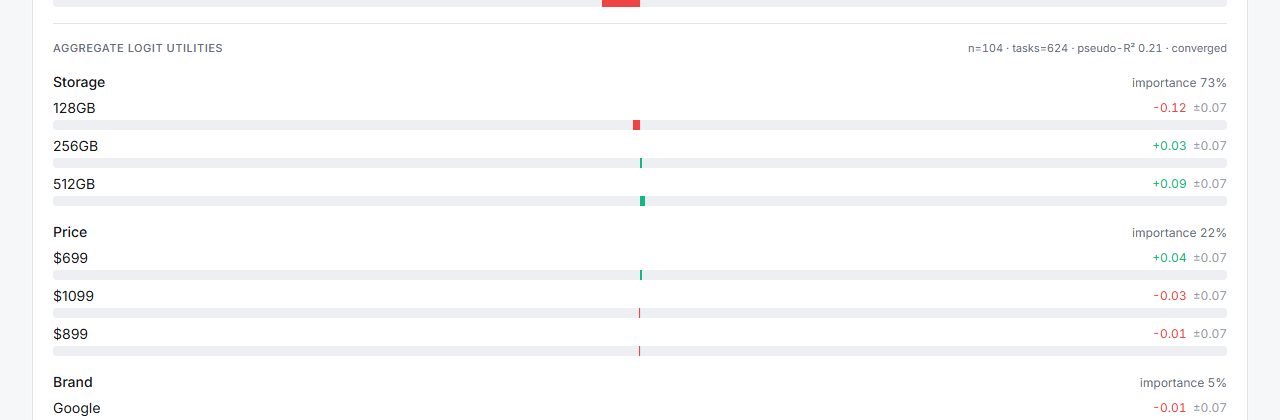
In the demo study: Storage 73%, Price 22%, Brand 5% — storage moved choices far more than brand did.
Step-by-step
Open the conjoint card in Results and read the importance figure beside each attribute name.
Rank the attributes — the ordering is your primary finding.
Sanity-check against the levels — importance is driven entirely by the range you tested, so read it together with the part-worths.
Tips
Tip: Importance is a property of your design, not a universal truth. Test $699–$1099 and price looks moderately important; test $699–$3,000 and price dominates — same market, different answer. Always report the levels alongside the importance.
Note: Importance percentages always sum to 100% across your attributes, so an attribute you left out simply doesn't exist in the result. A "brand is only 5% important" conclusion is only valid for the brands you actually tested.
Related articles
- Interpreting Part-Worth Utilities from MNL Output — the levels behind importance
- Defining Attributes and Levels for a CBC Study — how level ranges shape importance
- How Many Attributes Should Your Conjoint Study Include — near-zero importance means drop it