Advanced Research
Interpreting Best-Worst Score as a MaxDiff Preference Output
Read MaxDiff's best-minus-worst scores — what they mean, how they're computed, and what they can't tell you.
Overview
Read MaxDiff's best-minus-worst scores — what they mean, how they're computed, and what they can't tell you.
How the score works
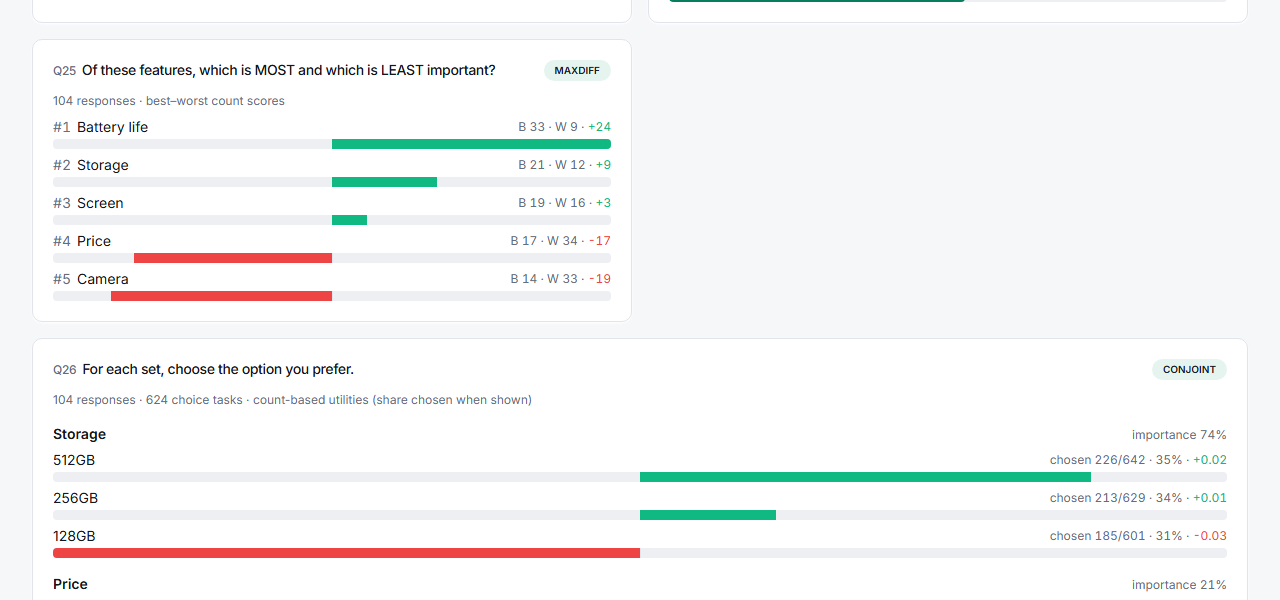
For each item, Surveti counts how often it was picked best and how often worst across all the sets it appeared in, then takes best minus worst. Items chosen best often and worst rarely score high; items nobody picks either way land near zero.
Step-by-step
Open the Results tab and find your MaxDiff question card.
Read the ranking — items are ranked by their best-minus-worst score.
Focus on the ordering and the gaps — the ranking is the finding; large gaps between adjacent items mean real separation, tight clusters mean the items are effectively tied.
Tips
Tip: The middle of a MaxDiff ranking is the least trustworthy part. Items near zero were rarely chosen either way — that could mean genuine indifference or simply that they were never the standout in their sets. Act on the top and bottom.
Note: These are count-based best-worst scores — a transparent, hand-checkable first-order statistic, not a model-based (HB) utility. They rank items reliably but aren't on a ratio scale: an item scoring twice another's score isn't "twice as preferred".
Related articles
- Exporting MaxDiff Aggregate Scores to CSV or Excel — take the scores away
- Setting Item Count and Items Per Set in a MaxDiff Study — design affects score stability