Advanced Research
How Many Attributes Should Your Conjoint Study Include
Pick a number of attributes your respondents can actually handle — usually far fewer than you'd like.
Overview
Pick a number of attributes your respondents can actually handle — usually far fewer than you'd like. Conjoint quality is limited by human attention, not by the estimator.
The guidance
- 4–6 attributes is the sweet spot for most CBC studies.
- Up to ~8 is workable if the attributes are simple and familiar.
- Beyond that, respondents start simplifying — they ignore attributes and choose on one or two cues. Your data then measures their coping strategy, not their preferences.
How to decide
Start from the decision you're modeling — include only the attributes that genuinely vary in the real choice.
Cut anything you can't act on — if you'd never change it, measuring its utility is wasted respondent effort.
Watch the Design quality indicator — the conjoint editor flags a design that's grown too complex to estimate well.
Check the importance spread after fielding — if several attributes come out near 0% importance, they were noise; drop them next wave.
Tips
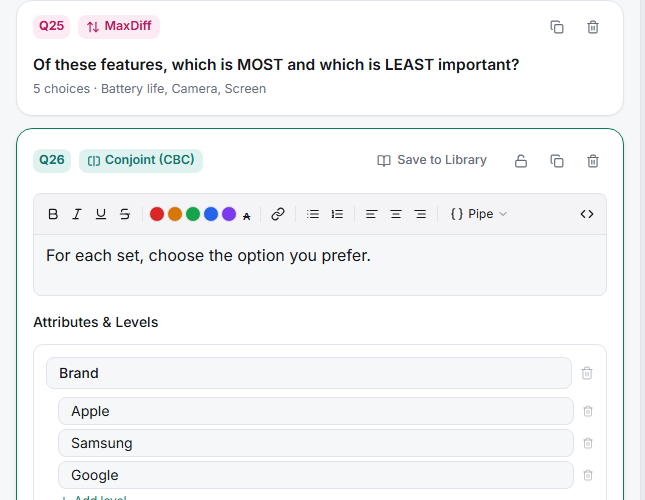
Tip: If your stakeholder list has 12 "must-have" attributes, run a MaxDiff first to find the 5 that matter, then conjoint those. That two-step is faster and produces better data than one enormous CBC.
Note: More attributes need more tasks to estimate the same precision — so complexity costs you twice: respondent fatigue and a longer survey.
Related articles
- Defining Attributes and Levels for a CBC Study — the build
- Choosing the Right Number of Tasks and Cards Per Task — sizing the design
- Getting Started with MaxDiff Best-Worst Scaling in Surveti — narrowing a long list first